
RhinoStop is an Australian-developed range of car park barriers built to absorb vehicle impact energy, reducing forces transferred to the anchor bolts and preventing damage to the concrete slab. The modular range has been developed for multi-storey, basement and split-level parking areas, shielding vehicles from a drop to a lower level. RhinoStop has become the preferred crash barrier solution for park & ride, retail centres, education facilities, health infrastructure and commercial developments.



When a car park barrier is required
A car park crash barrier is required for the protection of people, plant and equipment. This can include the shielding of pedestrian walkways, protecting valuable infrastructure, or preventing a vehicle from travelling over the perimeter edge of an elevated deck. The barrier should be capable of withstanding vehicle impact forces and preventing encroachment into the area behind the barrier system.
The guidelines of Australian Standard AS/NZS 2890.1 require a crash barrier to be installed whenever the drop to a lower level exceeds 600 mm. The crash barrier should not be constructed from material likely to shatter upon impact, including brickwork or unreinforced concrete. The crash barrier must be capable of withstanding the structural forces described in Australian Standard AS/NZS 1170.1.
The vehicle impact condition of a car park barrier is likely to occur perpendicular to the barrier, i.e., 90 degrees, at speeds up to 30 km/h.
Choosing the right RhinoStop system for your project
The selection of a RhinoStop barrier for your project considers the likely vehicle impact condition, the requirement to combine pedestrian fall protection and the type of hazard required to be shielded i.e. perimeter edge, ramp area, walkway, etc.
- RhinoStop Standard is an economical solution featuring w-beam guardrail panels supported by lightweight posts secured with just one (1) anchor bolt. Demonstrated containment of a 2000 kg vehicle travelling at 13 km/h and 90 degrees (13.0 kJ).
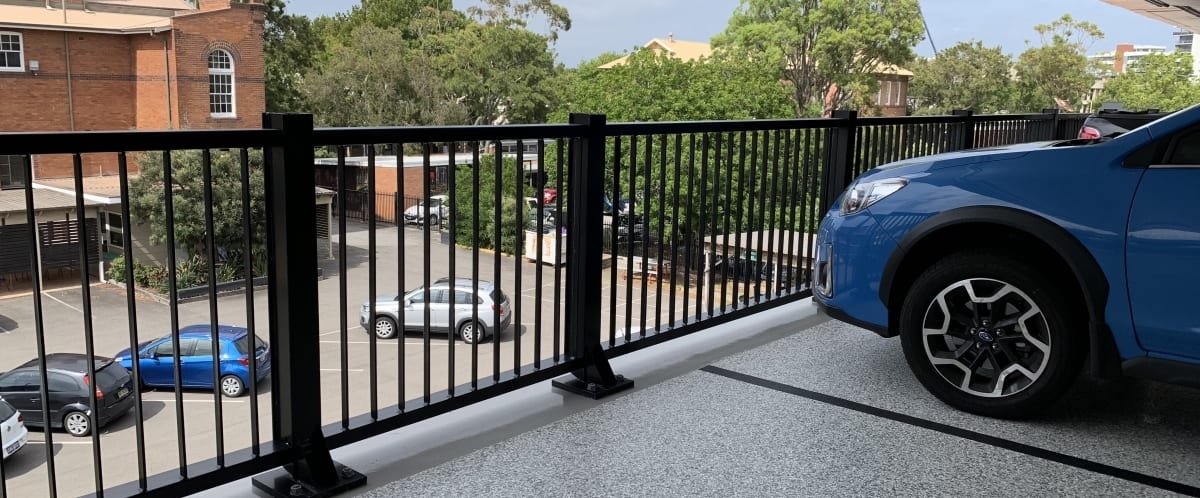
- RhinoStop Elite pairs vehicle impact containment with integrated pedestrian fall protection in a single architectural system, demonstrated containing a 2000 kg vehicle at 22 km/h and 90 degrees (37.2 kJ).
- RhinoStop Heavy Duty is designed for high speed applications and high-energy impacts including opposite down-ramps and straight aisles in car parks. Demonstrated containment of a 2000 kg vehicle travelling at 30 km/h and 90 degrees (67.2 kJ).
- RhinoStop TruckGuard features twin w-beam guardrails to withstand impact from high centre-of-gravity vehicles. Demonstrated containment of a 2500 kg light truck travelling at 20 km/h and 90 degrees (36.9 kJ) and impacting the barrier 1 m above ground level.
- RhinoStop Sky-Edge positions the barrier on the outer edge of an elevated concrete deck minimising encroachment into the parking area. Demonstrated containment of a 2000 kg vehicle travelling at 12 km/h and 90 degrees (11.7 kJ).
- RhinoStop Screen can be configured to a system height of up to 2.5 m providing an anti-climb and anti-throw barrier system. The ideal barrier for installation adjacent to critical infrastructure. Demonstrated containment of a 2000 kg vehicle travelling at 23 km/h and 90 degrees (39.7 kJ).
Our team of engineers can help you select the most appropriate RhinoStop configuration for your project. All RhinoStop barriers are full-scale crash tested to demonstrate compliance with Australian Standards, evaluating the capacity of the barrier and the yielding behaviour of the posts installed on a 150 mm thick concrete deck.
How does a RhinoStop barrier absorb vehicle impact energy?
Each RhinoStop system features energy-absorbing baseplates designed to deform during a vehicle collision. The steel baseplates feature slots cut into the baseplate that allow the system to deflect and absorb vehicle impact energy. The deflection of the system transfers loads to adjacent posts and reduces loading on the anchor bolts, preventing damage to the concrete deck.
Reducing forces transferred to the anchor bolts allows the number of anchor bolts per post to be reduced when compared to traditional car park barrier designs. Just one (1) or two (2) anchor bolts are required for most RhinoStop systems, facilitating rapid installation and reducing the potential for conflict with steel reinforcing. This is an important design consideration for constructors.
Our crash test configurations are designed to represent the ‘worst impact scenario’, distributing impact loads over fewer posts when installed on the edge of a 150 mm thick cantilevered concrete slab. Please refer to our impact compliance page detailing our crash testing considerations.
Frequently Asked Questions
A car park barrier is designed to withstand impacts from vehicle movements associated with parking. These impacts occur at speeds up to 30 km/h at high angles, i.e. 90 degrees. Unlike a road barrier, which features supporting posts driven into the ground, the posts of a car park barrier are often mounted to a concrete deck with base plates. Therefore, designers should consider the anchoring requirements of the posts and their ability to absorb impact energy. In addition, a car park barrier should also consider the movement of pedestrians and provide pedestrian fall protection where required.
The guidelines of Australian Standard AS/NZS 2890.1 requires a car park barrier to be installed wherever a drop to a lower level exceeds 600 mm. These areas include split-level areas, ramps and the perimeter edge of a multistorey car park.
A car park barrier system should demonstrate compliance to the impact loads described in Australian standard AS/NZS 1170.1. In addition, designers should also consider the crash test configuration of the barrier, its ability to withstand higher impact loads than those nominated by the Standard and the ability to configure the barrier with pedestrian fall protection.
AS/NZS 2890.1 provides the design and layout requirements for off-street parking, including multi-storey car parks, and references the loading requirements of Australian Standard AS/NZS 1170.1. The impact loads of AS/NZS 1170.1 are derived from vehicle impact conditions designed to represent the movement of vehicles in a parking area.
The Standard provides guidelines for Light Traffic Areas (Type F) and Medium Traffic Areas (Type G). A Light Traffic Area requires barriers to withstand a horizontal impact force of 30 kN or 240 kN depending upon the location of the barrier. The impact force shall be distributed over a 1.5 m length along the barrier and shall be assumed to act 0.5 m above ground level. A Medium Traffic Area requires barriers to withstand a horizontal impact force of 40 kN. The impact force shall be distributed over a 1.5 m length along the barrier and shall be assumed to act 1.0 m above ground level.
AS/NZS 1170.1 defines a Light Traffic Area as parking, garages, driveways and ramps used by cars, light vans and similar vehicles up to 2,500 kg gross mass.
AS/NZS 1170.1 defines a Medium Traffic Area as driveways, ramps, repair workshops, footpaths with vehicle access, and parking used by vehicles between 2,500 kg and 10,000 kg.
The Supplementary to the Standard states that the 30 kN, 240 kN and 40 kN impact forces are derived from a vehicle impact condition. For example, the 30 kN impact load is derived from a 1500 kg vehicle travelling at 2 m/s.This impact condition is considered inadequate and not representative of a likely impact scenario. In addition, the Standard does not provide guidelines for the crash test evaluation, including barrier length, vehicle impact location and concrete deck requirements. Drawing on decades of crash testing experience with roadside and car park barrier systems, we’ve developed our own crash test evaluation guidelines for RhinoStop barriers. These guidelines consider the ‘worst practical condition’ and build a factor of safety into every assessment. Our barrier systems are crash tested with a 2000 kg dual cab utility, representing the average mass of a new passenger vehicle sold in Australia. Barriers are tested on the edge of a 150 mm thick cantilevered concrete slab, representing installation on the perimeter edge of an elevated car park, at impact speeds significantly higher than those described by the Standard.
Crash testing evaluates how the barrier and vehicle behave during a real-life impact. Testing shorter installation lengths increases the loading on each supporting post, so RhinoStop systems are assessed under this harder condition. Positioning the posts on the edge of a thin slab also tests the strength of the anchor bolts and the ability of the baseplates to absorb impact energy without causing concrete edge failure.
New passenger vehicles sold in Australia now average around 2000 kg, reflecting the ongoing shift towards SUVs and dual-cab utes. RhinoStop barriers are crash tested against this heavier benchmark so the results reflect the vehicles actually on the road.
The patented design of each RhinoStop post features a slotted steel baseplate designed to yield during a vehicle collision. This design allows the system to deflect resulting in lower imposed forces. This feature reduces the number of anchors required for each post when compared to traditional systems. The yielding action also reduces the potential for damage to the concrete deck which is an important design consideration for asset owners.