
RhinoStop® car park barriers are an Australian-developed parking barrier range, built to absorb vehicle impact energy, reduce the forces on the anchor bolts and prevent damage to the concrete slab. The modular range of RhinoStop barriers has been developed for applications including multi-storey, basement or split-level parking areas to shield vehicles from a drop to a lower level. RhinoStop has become the preferred crash barrier solution for park & ride, retail centres, education facilities, health infrastructure and commercial developments.

Every RhinoStop barrier is a permanent installation, anchored to the concrete deck and full-scale crash-tested with a 2000 kg vehicle on the edge of a 150 mm thick slab. It is built for the edge protection Australian Standards require in car parks, not for temporary traffic control.

When a car park barrier is required

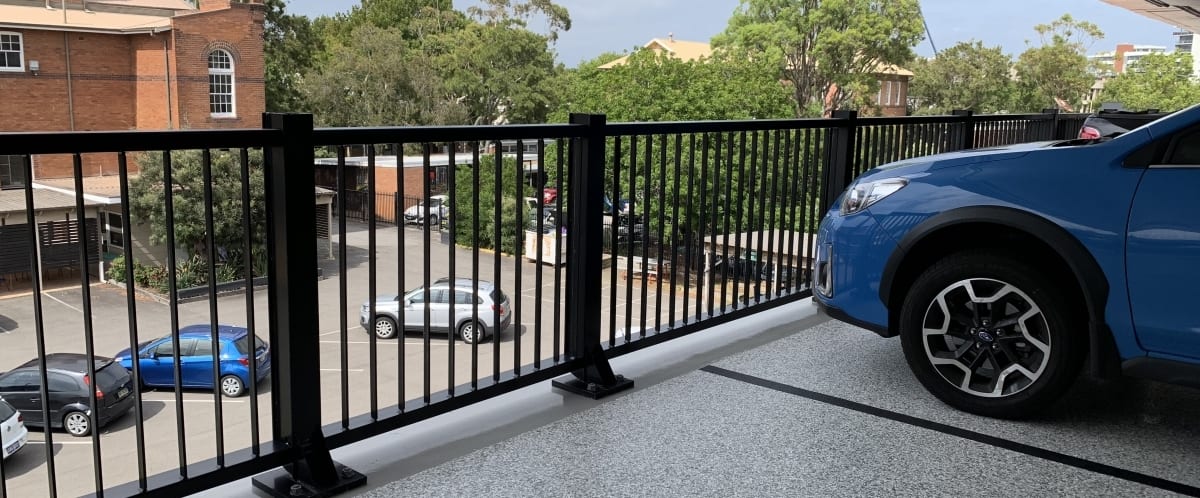
A car park crash barrier is required for the protection of people, plant and equipment. This can include the shielding of pedestrian walkways, protecting valuable infrastructure, or preventing a vehicle from travelling over the perimeter edge of an elevated deck. The barrier should be capable of withstanding vehicle impact forces and preventing encroachment into the area behind the barrier system.

Under the AS/NZS 2890.1 car park barrier requirements, a crash barrier is required whenever the drop to a lower level exceeds 600 mm. The crash barrier should not be constructed from material likely to shatter upon impact, including brickwork or unreinforced concrete. The crash barrier must be capable of withstanding the structural forces described in Australian Standard AS/NZS 1170.1.

The vehicle impact condition of a car park barrier is likely to occur perpendicular to the barrier, i.e. 90 degrees at speeds up to 30 km/h.

Choosing the right RhinoStop system for your project

The selection of a RhinoStop barrier for your project considers the likely vehicle impact condition, the requirement to combine pedestrian fall protection and the type of hazard required to be shielded, i.e. perimeter edge, ramp area, walkway, etc.

Barrier Designed for Demonstrated containment (90 degree impact)
RhinoStop® Standard An economical w-beam guardrail on lightweight posts, each secured with one anchor bolt 2000 kg vehicle at 13 km/h (13.0 kJ)
RhinoStop® Elite Vehicle containment with integrated pedestrian fall protection in a single architectural system 2000 kg vehicle at 22 km/h (37.2 kJ)
RhinoStop® Heavy Duty High-speed, high-energy impacts, including opposite down-ramps and straight aisles 2000 kg vehicle at 30 km/h (67.2 kJ)
RhinoStop® Truck-Guard Twin w-beam guardrails for high centre-of-gravity vehicles 2500 kg light truck at 20 km/h, impacting 1 m above ground (36.9 kJ)
RhinoStop® Sky-Edge Mounting on the outer edge of an elevated deck, minimising encroachment into the parking area 2000 kg vehicle at 12 km/h (11.7 kJ)
RhinoStop® Screen An anti-climb and anti-throw barrier up to 2.5 m high, for installation next to critical infrastructure 2000 kg vehicle at 23 km/h (39.7 kJ)

Our team of industry experts can help you select the most appropriate RhinoStop configuration for your project. All RhinoStop barriers are full-scale crash tested to demonstrate compliance with Australian Standards. Our crash testing evaluates the capacity of the barrier and the yielding behaviour of the posts installed on a 150 mm thick concrete deck.

How does a RhinoStop barrier absorb vehicle impact energy?

Each RhinoStop system features energy-absorbing baseplates designed to deform during a vehicle collision. The steel baseplates feature slots cut into the baseplates that allow the system to deflect and absorb vehicle impact energy. The deflection of the system transfers loads to adjacent posts and reduces loading on the anchor bolts, preventing damage to the concrete deck.

Reducing forces transferred to the anchor bolts allows the number of anchor bolts per post to be reduced when compared to traditional car park barrier designs. Just one (1) or two (2) anchor bolts are required for most RhinoStop systems, facilitating rapid installation and reducing the potential for conflict with steel reinforcing. This is an important design consideration for constructors.

Our crash test configurations are designed to represent a ‘worst impact scenario’, distributing impact loads over fewer posts when installed on the edge of a 150 mm thick cantilevered concrete slab. Please refer to our impact compliance page detailing our crash testing considerations.

Talk to a RhinoStop industry expert

Our industry experts can recommend the most appropriate RhinoStop barrier and configuration for your car park. Call 1300 150 733 or send us an enquiry.

Frequently asked questions

A car park barrier is designed to withstand impacts from vehicle movements associated with parking. These impacts occur at speeds up to 30 km/h at high angles, i.e. 90 degrees. Unlike a road barrier, which features supporting posts driven into the ground, the posts of a car park barrier are often mounted to a concrete deck with base plates. Therefore, designers should consider the anchoring requirements of the posts and their ability to absorb impact energy. In addition, a car park barrier should also consider the movement of pedestrians and provide pedestrian fall protection where required.

The guidelines of Australian Standard AS/NZS 2890.1 require a car park barrier to be installed wherever a drop to a lower level exceeds 600 mm. These areas include split-level areas, ramps and the perimeter edge of a multi-storey car park.

A car park barrier system should demonstrate compliance with the impact loads described in Australian Standard AS/NZS 1170.1. In addition, designers should also consider the crash test configuration of the barrier, its ability to withstand higher impact loads than those nominated by the Standard and the ability to configure the barrier with pedestrian fall protection.

Australian Standard AS/NZS 2890.1 provides the design and layout requirements for off-street parking, including multi-storey car parks, and references the loading requirements of Australian Standard AS/NZS 1170.1. The impact loads of AS/NZS 1170.1 are derived from vehicle impact conditions designed to represent the movement of vehicles in a parking area.

AS/NZS 1170.1 provides guidelines for Light Traffic Areas (Type F) and Medium Traffic Areas (Type G). A Light Traffic Area requires barriers to withstand a horizontal impact force of 30 kN or 240 kN depending upon the location of the barrier. The impact force shall be distributed over a 1.5 m length along the barrier and shall be assumed to act 0.5 m above ground level.

A Medium Traffic Area requires barriers to withstand a horizontal impact force of 40 kN. The impact force shall be distributed over a 1.5 m length along the barrier and shall be assumed to act 1.0 m above ground level.

AS/NZS 1170.1 defines a Light Traffic Area (Type F) as parking, garages, driveways and ramps used by cars, light vans and similar vehicles up to 2,500 kg gross mass. A Medium Traffic Area (Type G) covers driveways, ramps, repair workshops, footpaths with vehicle access, and parking used by vehicles between 2,500 kg and 10,000 kg.

The Supplementary to the Standard states that the 30 kN, 240 kN and 40 kN impact forces are derived from a vehicle impact condition. For example, the 30 kN impact load is derived from a 1500 kg vehicle travelling at 2 m/s.

This impact condition is considered inadequate and not representative of a likely impact scenario. In addition, the Standard does not provide guidelines for the crash test evaluation, including barrier length, vehicle impact location and concrete deck requirements.

Drawing on decades of crash testing experience with roadside and car park barriers, we have developed our own crash test evaluation guidelines for RhinoStop barriers. These guidelines consider the worst practical condition and build a factor of safety into every assessment. Our barriers are crash tested with a 2000 kg dual cab utility representing the average mass of a new passenger car sold within Australia. Barriers are crash tested on the edge of a 150 mm thick cantilevered concrete slab representing installation on the perimeter edge of an elevated car park, and vehicle impact speeds are significantly higher than those described by the Standard.

Crash testing evaluates the performance of the barrier system during a real-life impact scenario. Crash testing evaluates the behaviour of the barrier and vehicle during impact. We crash-test short installation lengths, increasing the loading on the supporting posts. The positioning of the posts on the edge of a thin slab also evaluates the strength of the anchor bolts and the ability of the baseplates to absorb impact energy and prevent concrete edge failure.

The average mass of a new passenger vehicle sold in Australia is 2000 kg as the market shifts towards SUV and dual cab utilities. All RhinoStop barriers are crash-tested with this heavier vehicle to represent a real-life impact scenario.

It depends on the barrier and whether it also provides pedestrian fall protection. AS/NZS 1170.1 assumes the vehicle impact acts 0.5 m above ground level in Light Traffic Areas (Type F) and 1.0 m above ground level in Medium Traffic Areas (Type G). Published heights for the RhinoStop range are:

  • RhinoStop® Elite: an 1100 mm high balustrade, with 97 mm gaps between the balusters to restrict climbing.
  • RhinoStop® Truck-Guard: a double-height W-beam rail that stands 1.0 m off the ground, built for the Type G impact height.
  • RhinoStop® Standard: can be configured with pedestrian fall protection up to 1300 mm high.
  • RhinoStop® Screen: five standard overall heights of 1300, 1500, 1900, 2200 and 2500 mm.
  • RhinoStop® Heavy Duty and RhinoStop® Sky-Edge can be fitted with a handrail and mesh infill where pedestrians need fall protection.

Our industry experts can confirm the installed height for your site.

Yes. RhinoStop® Elite combines vehicle containment with integrated pedestrian fall protection in a single system, and RhinoStop® Screen can be configured up to 2.5 m high as an anti-climb and anti-throw barrier. Our engineers can advise which configuration suits the hazard on your site.

The patented design of each RhinoStop post features a slotted steel baseplate designed to yield during a vehicle collision. This design allows the system to deflect, resulting in lower imposed forces. This feature reduces the number of anchors required for each post when compared to traditional systems. The yielding action also reduces the potential for damage to the concrete deck, which is an important design consideration for asset owners.